Loading interactive demo...
Further Reading
The Silicon Proxy: Mind Mapped to Machine
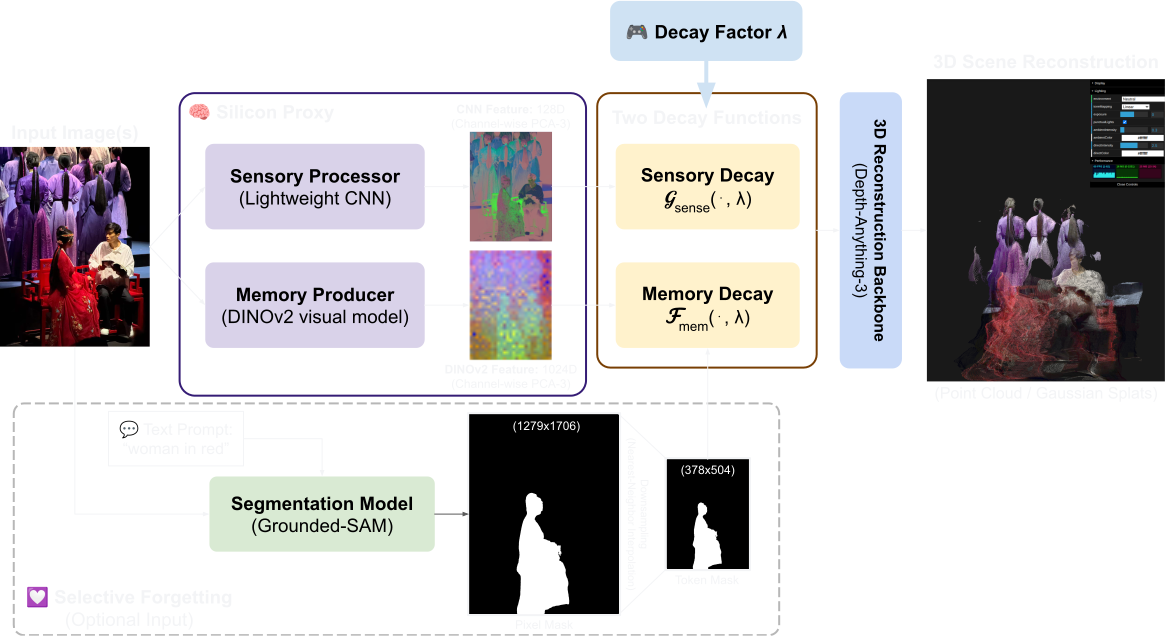
Modern vision models share structural principles with biological vision: distributed representation, hierarchical feature extraction, and predictive coding. Echoes of the Prior exploits this analogy by treating a state-of-the-art 3D Gaussian Splatting model not as a renderer, but as a cognitive proxy — a silicon brain whose components map onto two streams of human perception:
- The Sensory Stream — A shallow CNN processes raw pixel input, capturing texture and local geometry of the Now. This mirrors the biological retina and primary visual cortex (V1).
- The Memory Stream — A vision foundation model (DINOv2) encodes high-dimensional semantic priors — the machine's long-term memory of what the world should look like.
In a healthy state, perception is the successful integration of these two streams. Our installation visualizes what happens when they decay.
Two Modes of Forgetting
We introduce two entropy operators that simulate distinct biological failure modes, grounded in the Neural Gain Theory of Aging:
Sensory Decay ($\mathcal{G}_\text{sense}$) — Rather than degrading the input image, we corrupt the processing circuitry itself. Three mechanisms act on the CNN weights: (i) Spectral Amnesia: high-frequency filters are suppressed via FFT masking, simulating loss of visual acuity; (ii) Neural Fabrication: spatially coherent noise is injected, causing the machine to hallucinate phantom textures; (iii) Structural Atrophy: stochastic dropout zeroes out synaptic connections, rendering perception sparse and ghostly.
Memory Decay ($\mathcal{F}_\text{mem}$) — Biological forgetting is not fading to black; it is the world turning wrong. We model this by applying a continuous orthogonal rotation to the semantic feature vectors, twisting the memory manifold while preserving signal strength. The machine continues to reconstruct confident geometries, but familiar objects become hallucinated topological variants — a building does not pixelate but melts. This creates what we term a computational uncanny valley: an intermediate decay zone (0.3 < $\lambda$ < 0.7) where representations are structurally strong yet semantically distorted, producing maximally disturbing imagery.
Selective Forgetting
Human memory loss is often selective — we forget specific faces, names, or objects while the surrounding reality remains intact. Our system supports this through object-oriented amnesia: users can specify a target (e.g., "the woman in red") via text prompt, and entropy is surgically injected only into the corresponding latent tokens. The result is a world perfectly remembered except for one conspicuous absence — a ghost-shaped void.
Why 3D Gaussian Splatting?
We deliberately chose monocular depth reconstruction over generative 3D models. While generative approaches fabricate watertight, solid meshes by inventing unseen geometry, human memory is not a solid object — it is a surface, a facade. Our system produces a fragile 2.5D shell that appears coherent from the original viewpoint but reveals its hollowness when rotated. This Potemkin village effect is not a technical limitation but a deliberate aesthetic metaphor: memory is a thin film stretched over a void.
For full technical details, formal derivations, and discussion, please refer to the full paper.